
Archive for March 2008
Vankaya Kothmir Kaaram (Eggplant with cilantro chutney)
As I mentioned earlier, this blog is all about recipes old, borrowed and inspired, and umm..some original ones in between. Now I have have always enjoyed reading food blogs, recipes and indulging in conversations around cooking, it was more than ever now that I started this food journal. It’s almost like every conversation these days sparks an idea to try something new and it’s amazing how inspiration can strike. Sometimes it’s from a restaurant menu, lunches and dinners at friend’s houses or just plain food talk!
So I was out at lunch with my “lunch buddy” at work, Padma, at a soup and sandwich place, and sure enough, our talk meandered to good food combinations. I think for me, it was more because my soup was a little bland for my taste, so I figured that talk about spicy food might make it better? So Padma got talking about the quick and easy eggplant curry she had made the previous evening and how good it tasted with hot, steaming white rice. I have to add that she is not only a good cook but an eloquent foodie…it tempted me enough to try it at home the very evening. Padma is from Andhra hence the original name of the recipe..Vankaya Kothmir Karam. Thank you, Padma for your contribution to this blog.
Ingredients:
Small eggplant (7-8), chopped into cubes
I also tried this recipe with the long Japanese eggplant and did not find much difference in taste except that the long ones cook faster. Any guesses for which one I recommend for this already quick recipe?
Green chilies – 4-5 (depending on how spicy you want the dish to be)
Cilantro – a big bunch
Oil – 1 tbsp
1. Heat a heavy bottomed vessel or kadai and add the 1 tbsp oil.
2. When the oil is hot, add the chopped eggplant to it. Turn the flame to medium heat and let the eggplant saute in the oil for a while, till it starts to look a little mushy and the oil starts to seep.
3. In the interim, grind the cilantro and green chilies to a fine paste with some salt in a blender.
4. Now add the cilantro paste to the cooked eggplant and simmer on low fire for about 10 minutes till well cooked.
5. Enjoy with steaming hot rice!
The recipe does not call for any tadka or seasoning, as the cilantro-green chilies provide all the flavor for this dish.
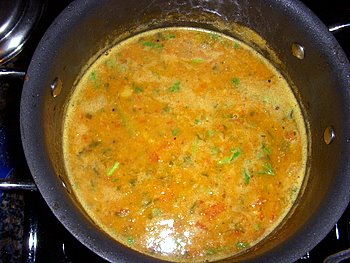
(I couldn’t get a great picture of the finished dish. The last picture with the cilantro paste is not of the finished dish but just minutes after I added the cilantro paste. You will need to cook it for about 10 minutes more after adding the paste!)
The Sambar (Lentil Soup)
Yes. I know this is quite an unusual title for something as commonplace as sambar, but I have a reason for naming this recipe the way I did. This is THE contribution from Anusuya’s kitchen. I will not be exaggerating when I say that this is her signature dish. Well, I had the good fortune of jotting down the recipe verbatim as told by her and also tried it not once, but twice, and the result was amazing. I say that because sambar has never been my forte, at least the way I have always made it, and this was not only easy but dosai-licking good! As you can tell, we had it with hot dosai and it was a hit! Here goes the recipe…
Ingredients:
Please note that this recipe is for a 2 quart container and should serve about 4 people.
Toor dal (yellow lentils) – 1/2 cup, pressure cooked till soft
Ghee – 1 tsp
Oil – 1 tsp
Shallots – 7-8 (peeled)
Saragawa (Murungakkai in Tamil also commonly known as “drumsticks”- not the chicken kind) – 7-8. I used frozen ones.
Tamarind paste – 2 tsp (You can also use a lemon size ball of fresh tamarind soaked in water to make a paste)
Sambar powder – 2 tsp (I used MTR Madras sambar powder. Make sure its the Madras kind and not the regular Sambar powder)
Tomatoes – 2, diced (You can also use half can of diced tomatoes for this.)
Cilantro – half bunch
Asafoetida – a pinch
Grind to a paste the following: 2 tbsp dhania seeds (coriander), 2-3 red chillies, 1/2 tsp methi seeds (fenugreek). Fry the above till the dhania starts to crackle. Add 2 tbsp of dessicated coconut. Medium fry all the above till you get a coconutt-y aroma. Now grind all the above in a blender. You can also use 2-3 tbsp of coconut milk while grinding to enhance the taste of the coconut.
For the sambar, heat the ghee and oil in a 2 quart vessel. Add mustard seeds. When it starts to crackle, add the onions and saragawa and fry well till cooked.
Add about 1 quart of water to this, add the tamarind paste, the sambar powder, cilantro, diced tomatoes. Add salt to taste and boil well till the raw smell of the sambar powder goes away. Add the boiled toor dal to this mixture and boil for a few more minutes. Now add the ground coconut/dhania paste to this and boil again for 5-10 minutes. The Sambar is ready!
A tip from Anusuya is to simmer the sambar in a crock pot on low for 1-2 hours to get the most out of its taste. I didn’t try this myself but can attest to the taste from having tried it at her home!
Sabudana Khichdi (Sago Stir Fry)
Sabudana is the Hindi/Marathi/Bengali/Oriya word for pearl sago. Sabudana grains look like tapioca and are small (about 2 mm diameter) dry, white balls. Sabudana is called javvu arisi in Tamil, sabbakki in Kannada and saggu biyyam in Telugu. When cooked they turn from their opaque white color to translucent, and become soft and spongy. In North and western India it is most commonly used in fasting dishes, such as sabudana khichdi (generally made using soaked sabudana, fried with potatoes, chilli and peanuts) and sabudana vada. In South India they are used to make small pappadam wafers, sabudana vada and also for making a variant of a sweet semi liquid dessert called kheer or payasam.
The word sabudana itself is made up of two words, sabut (meaning ‘whole’) + dana (meaning ‘grain’ or ‘seed’)
As mentioned earlier, this sabudana khichdi entry is from Anusuya’s Kitchen, her original method of making this versatile dish (not exactly sure why it was called the fasting dish, but can be eaten for breakfast, lunch, dinner or as a snack)
Ingredients:
Sabudana – 2 cups
Roasted peanuts (crushed) – 1/2 cup
Large green bell pepper (diced) -1
Green chilies
Medium sized red potato (cubed) – 1
Medium sized red bell pepper (chopped) -1
Oil – 2 tbsp
Cumin seeds – 1 tsp
Urad dal – 1 tsp
Mustard seeds – 1 tsp
Chopped cilantro – 1/2 bunch
Chutney powder – 4tsp (This is also known as milagai podi in Tamil, commonly as chutney powder as it is eaten with idly and dosai. Made with a combination of sesame seeds, dals and red chilies, this “gun-powder” is the perfect ingredient to fire up your sabudana khichdi.)

Wash the sabudana well. Soak it in 1 cup of water for about 5-6 hours. (You can also soak this overnight if necessary). Heat the oil in a heavy bottomed vessel or kadhai. Also make sure to coat the pan with baking spray. I would say this is an important step as it ensures the sabudana doen’t stick to each other and form clumps when you put it in the kadhai. Add the cumin, urad, mustard seeds. When the mustard seeds start to crackle, add the chopped green chilies. Now add the chopped vegetables and fry for about 5 minutes, till they are cooked. Add the soaked sabudana now and stir well to mix the vegetables with the sabudana and the tadka ingredients. Now add the chutney powder, crushed peanuts and salt to taste. Mix well.
As the final step, transfer the sabudana khichdi to a microwavable dish, and heat on high for about 3 minutes. This important step enables the sabudana to soak in the masalas evenly, to add the right amount of “kick” to the dish. Add chopped cilantro for garnish and serve hot.
Anusuya’s Kitchen
I would be remiss if I didn’t dedicate a section of this blog to a gourmet cook, someone who is a fellow foodie but also the inspiration of many of the recipes posted here.
We share the enthusiasm of browsing the Mahanandi’s and the Saffron Hut’s of the blog world, talking about food, and of course, critiq-ing them. I don’t call myself a great cook, but a decent food critic…she, rather is great at both!. She is the gourmet among us, so I wanted to create a section of her tried and true recipes here and almost use this as her mini-blog of her original recipes. Some of the recipes in here are those that I have tried to make in my kitchen but I will be sure to add in pictures and food from her kitchen as well as we go (that way, I get to taste her kitchen creations as well;).
Ridged Gourd Dal (Peerkangai Paruppu)
This dal dish is one that I learnt from my mil. The lemon juice and green chilies in this dish impart a very tangy and spicy twist to this everyday dal (or koottu in Tamil).
Ingredients:
Ridged gourd – 2, peeled and chopped into small pieces
Urad dal – 1 1/2 tsp
Mustard seeds – 1 tsp
Chana dal (yellow pigeon peas) – 1 1/2 tsp
Curry leaves – a few
Cumin seeds (jeera) – 1 tsp
Ginger, chopped – 1 tsp
Juice of half a lemon
Cilantro – 2 tsp chopped
1 cup boiled and mashed toor dal
Oil - 1 tsp
Heat the oil in a kadhai or heavy bottomed vessel. Add the mustard seeds, jeera, urad dal, chana dal, and curry leaves. Wait for the mustard seeds to crackle, then add the chopped ginger and green chilies. Fry for about 2-3 minutes and then add the ridged gourd pieces. Saute for about 5-7 minutes until the ridged gourd looks a little transparent and feel soft to the ladle, and all the water evaporates. This step may take a little time. Make sure to completely cook the ridged gourd. Now add the boiled and mashed toor dal to this mixture. Add a little water if needed (about half cup). I usually add a little turmeric powder to the toor dal, but if not, you may add the turmeric powder here.
Let the dal boil a little (about 5 minutes). Turn off the stove and add the juice of half a lemon. Garnish with chopped cilantro and serve with steamed white rice.
Red Potato with Spring Onion (Alu Hare Pyaaz ki Subzi)
This was just a very slight variation from the usual potato fry or alu pyaaz sabzi. Just that I didn’t have the usual Idaho potatoes in my pantry. Making do with the small red potatoes, I figured they were also easier to cook, since the skin is so much thinner than the usual potatoes. Also, it’s not absolutely necessary to peel the skin, though we know that keeping the skin on helps retain the nutrients. Overall it was a time saver, which as I said earlier, are the buzz words in my kitchen, so red potatoes and spring onions was the sabzi (vegetable) for the day. Spring onion gave this sabzi an extra bite which was an added benefit. The recipe I have here is for the usual South Indian style, but I also tried it with garam masala and tawa fry masala and the result was as tasty. You can’t go wrong with potatoes anyway!
Ingredients
Small red potatoes – 8
Spring onions – 2 bunches
Oil – 1 tbsp
Urad dal – 1 tsp
Mustard seeds – 1 tsp
Chana dal – 1 tsp
Chili powder – 1 tsp
Turmeric powder – 1 tsp (optional)
Salt to taste
Heat the oil in a flat bottomed vessel. Add the mustard seeds, urad dal, cumin seeds and chana dal. Wait for the mustard seeds to splutter. Then add the spring onions and sauté till they glaze. (You can also add grated ginger and grated garlic here if you would like, I didn’t for the South Indian style method)Add the cubed/chopped red potatoes. Add the turmeric powder, chili powder and salt. (Add garam masala and tawa fry masala here if making the North Indian style, and dhania powder if needed, 1 tsp each)Cook this on a very slow fire for about 15 to 20 minutes, stirring occasionally till the potatoes have a perfect golden hue. Enjoy with rice or chapathis.
Cauliflower Fry
This is a favorite accompaniment to the tomato paruppu rasam in my home. In many South Indian (Tamil) homes, cauliflower curry is usually boiled cauliflower sautéed lightly with coconut added as a garnish. That was how it was made at my home growing up, but it wasn’t my favorite way of eating cauliflower. Once boiled in the pressure cooker or otherwise, cauliflower loses its texture and I think even it’s taste to some extent. My favorite method for South Indian style cauliflower fry is to just fry it, like okra or potatoes, with the “usual” tadka. Here is the simple recipe. Enjoy it with rice and hot rasam!You can cook most vegetables (potato, okra, bitter gourd, taro root etc.) this way to give it that South Indian “fry” taste.
Ingredients: Cauliflower – 1, stem removed and cut into florets
Oil – 2 tsp
Urad dal – 1-2 tsp
Mustard seeds – 1-2 tsp
Jeera (cumin seeds) – 1 tsp
Asafoetida – a pinch
Dry red chillies – 2-3 (optional)
Turmeric powder (haldi) – 1 tsp
Red Chilli Powder – 1 tsp or to taste
Salt to taste
Cilantro for garnish
Heat the oil in a flat bottomed pan or skillet. Add the urad, mustard seeds, jeera and asafoetida. If you like spicy food like me, you can also add the dry red chillies here. When the mustard seeds splutter, add the cauliflower. (Note: Make sure to wash and then completely dry the cauliflower before you add it to the pan. If there is water, it tends to get mushy and reduces the crispness of the dish.)
Now add the turmeric powder and the red chilli powder. Mix so the powders coat the vegetable evenly. Let the vegetable mix cook on a slow fire for about 10 minutes, stirring it occasionally. Now add the salt, and cook on slow fire for another 5-7 minutes. Add cilantro for garnish (optional).